

Lance Chandler • March 20, 2026
Why Insurance Premiums Are Different in Murfreesboro and Nashville
Confused as to why premiums are so different? Here's why!
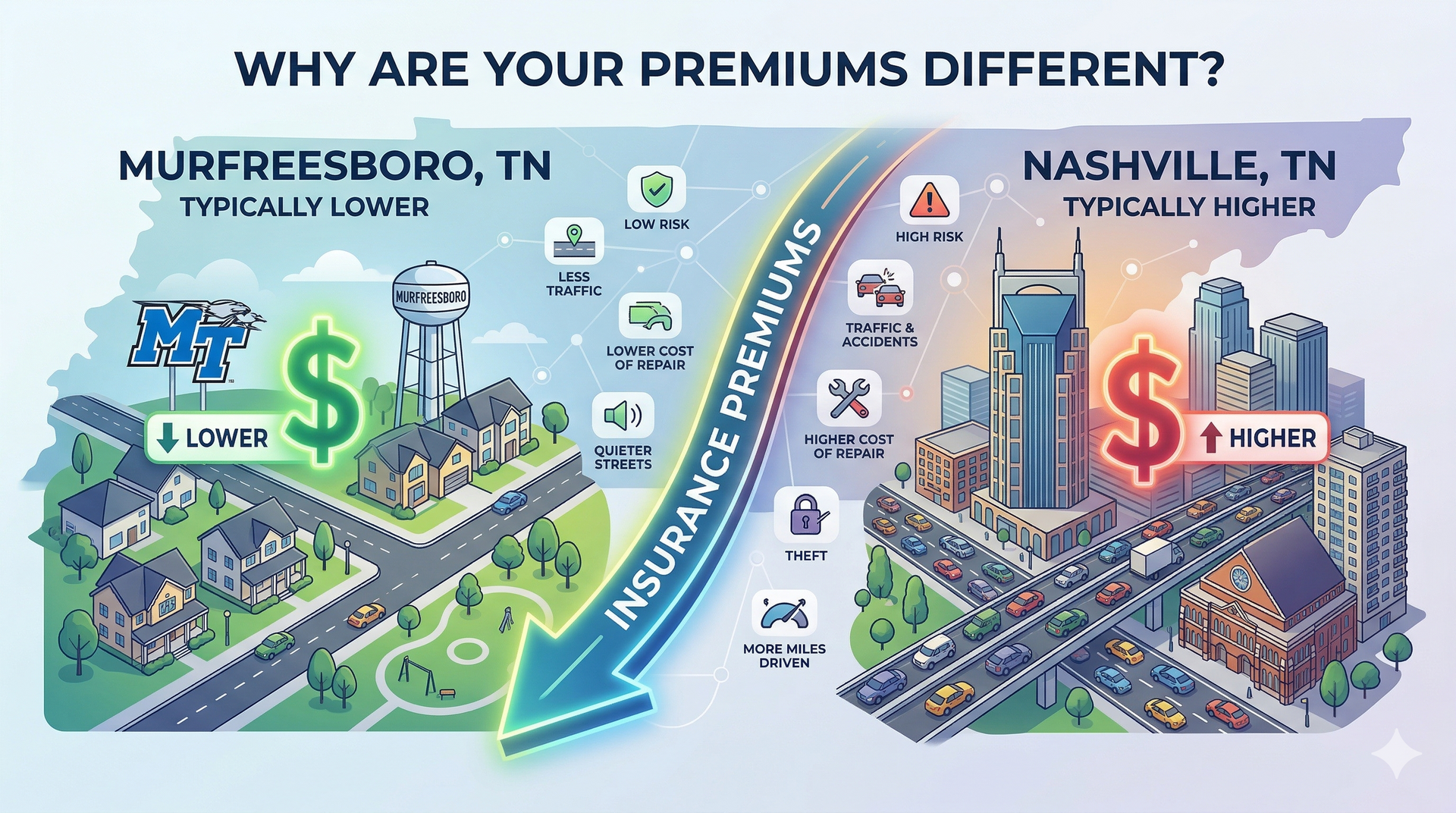
If you’ve ever compared insurance quotes between Murfreesboro and Nashville—even for the exact same vehicle, home, or coverage—you’ve probably noticed a frustrating truth: the premiums aren’t the same.
Even though the cities are only about 35 miles apart, their insurance rates can look completely different. Many Middle Tennessee residents move between the two areas and are surprised to learn that their cost of living shifts in ways they weren’t expecting, especially when it comes to insurance.
So why does this happen? Why can two cities in the same region, with many of the same weather patterns and similar lifestyles, have noticeably different insurance premiums?
Let’s break it down in clear, simple terms.
1. Population Density and Traffic Risk
Nashville is significantly larger, busier, and more congested than Murfreesboro.
More people on the road = more chances for accidents.
Insurance companies track frequency of claims as one of their biggest rating factors.
Nashville historically experiences:
- Higher accident rates
- More traffic congestion
- More distracted driving incidents
- More costly vehicle collisions
Even if you are a safe driver, the environment around you still affects your rate. Insurers see Nashville as a higher-risk driving environment compared to Murfreesboro, and that gets built into premiums.
Murfreesboro has grown quickly, but the traffic volume and accident frequency are still lower overall, which helps keep average premiums down.
2. Crime Rate Differences
Another major rating factor is crime,
especially:
- Vehicle theft
- Vandalism
- Property theft
- Break-ins
Nashville’s higher population and urban structure naturally lead to higher crime statistics. Insurance companies don’t just look at citywide data—they zoom in to the ZIP code level. Some Nashville ZIP codes have much higher risk ratings due to theft and vandalism.
Murfreesboro, while growing, still has lower crime rates in comparison. Lower crime = lower likelihood of claims = lower insurance premiums.
3. Cost of Living & Repair Costs
Insurance companies consider what it costs to repair a home or a vehicle in a specific market. Nashville’s rapid growth and booming development have caused:
- Higher labor costs
- Higher contractor rates
- Higher material costs
- More expensive body shops and mechanics
Because repairs often cost more in Nashville, insurance companies adjust premiums accordingly. A fender bender, water leak, or damaged roof can cost several hundred dollars more to fix in Nashville than in Murfreesboro—and insurers plan for that.
Murfreesboro’s cost of repairs is rising too, but still generally sits below Nashville’s levels.
4. Weather and Environmental Risk Categories
Even though the cities sit close together geographically, they can fall into different underwriting categories. Insurance carriers analyze things like:
- Flood risk
- Storm pathways
- Tornado history
- Soil & foundation movement
- Microclimates
Some Nashville ZIP codes have slightly higher historical storm-loss data or are designated as higher flood-risk zones. Murfreesboro may have pockets with different weather patterns or fewer high-cost weather-related claims.
Small environmental differences add up over time and impact premiums.
5. Community Infrastructure & Emergency Response
This is a factor many people never think about.
Insurance models actually evaluate:
- Average EMS response time
- Fire department proximity
- Hydrant availability
- Road structure
- Hospital access
Because parts of Nashville are more densely populated, emergency response times can be longer. Some older neighborhoods also have older infrastructure that increases risk.
Murfreesboro, on the other hand, has undergone lots of recent development with newer roads, updated hydrant systems, and strong municipal planning. More predictable emergency response = lower risk.
6. Home Values and Rebuild Costs
For home insurance, the value of the house is not what matters—the replacement cost is what insurers analyze.
Nashville rebuild costs tend to be higher because of:
- Higher labor demand
- Contractor shortages
- Rising material costs
- Increased construction load from growth
If a home is damaged in Nashville, it often costs more to rebuild it than a similar home in Murfreesboro. Even if homes appear identical, their replacement cost calculations may differ based on local economic pressures.
Higher rebuild cost = higher premium.
7. Legal and Medical Claim Trends
Insurance companies also look at how expensive claims tend to be in each area. Nashville, being more urban, sees:
- Higher medical claim costs
- More attorney involvement in auto claims
- Higher frequency of liability lawsuits
This is a major driver of car insurance differences.
Murfreesboro historically has fewer attorney-represented claims and lower average medical costs per accident. This leads to lower premiums for liability and injury coverage.
8. ZIP Code–Specific Rating Algorithms
This is the part most people don’t realize:
Your insurance rate isn’t based on your entire city—it’s based on your ZIP code.
Every carrier has its own risk map. Nashville ZIP codes vary dramatically: 37207, 37208, 37211, 37209—each one has different patterns of:
- Accidents
- Theft
- Claim costs
- Weather losses
- Fraud rates
Some Nashville ZIP codes are among the highest-rated for risk in the entire state.
Murfreesboro ZIP codes tend to fall into more moderate categories, so premiums remain more stable.
9. Growth Patterns and Claim Volatility
Nashville’s growth has been explosive, which leads to:
- More new drivers on the road
- More inexperienced drivers
- More people unfamiliar with local traffic patterns
- More new developments that shift road layouts
All of this increases claim volatility.
Murfreesboro is growing fast too, but not at the same unpredictable pace. Communities with steadier growth often have more stable insurance pricing.
10. Competition Among Insurance Companies
Some carriers simply price the two cities differently based on their own goals.
For example:
A company may want to grow its market share in Murfreesboro and offer lower rates there.
Another company may pull back from insuring certain Nashville ZIP codes due to high claim losses.
When fewer companies want to write policies in a specific area, premiums rise.
More competition = lower prices.
Less competition = higher prices.
Nashville struggles with this more than Murfreesboro.
Bottom Line
Even though Murfreesboro and Nashville are neighbors, they’re treated very differently by insurance companies. Differences in crime rates, claim history, rebuild costs, traffic congestion, and even emergency response times all play a role in shaping premiums.
Insurance pricing isn’t personal—it’s mathematical.
Carriers look at risk data ZIP code by ZIP code.
If you’re moving between the two cities, or if you’re just trying to understand why your premium looks the way it does, remember: it’s not just your driving history or your home. It's everything around you.
And if your rates recently went up, it doesn’t always mean you did anything wrong—it might just mean your area experienced higher claims or your ZIP code’s risk category changed.
Written by Lance Chandler. Lisenced in TN & KY.